Freight Forwarding Singapore (2026): Air, Sea & Land Options Explained
Singapore is one of Asia’s most connected trade hubs, with Changi Airport ranking among the world’s top air cargo gateways and the Port of Singapore consistently rated the world’s busiest transhipment hub. For ecommerce brands importing goods from China, Europe, or the United States — or distributing to markets across Southeast Asia — understanding freight forwarding is not optional. It is the foundation of a reliable, scalable supply chain.
Quick Answer: Freight Forwarding in Singapore
- Air freight: 3–7 days transit, highest per-kg cost, best for time-sensitive or high-value goods
- Sea freight (FCL/LCL): most cost-effective for bulk cargo, 5–35 days depending on origin
- Land freight: 1–3 days, best for Malaysia and Thailand corridors, limited to regional routes
- A freight forwarder handles documentation, carrier booking, customs coordination, and Incoterms compliance
- Pairing a forwarder with a Singapore 3PL like BrickHub creates a seamless inbound supply chain — from port to warehouse to customer
The freight mode you choose determines your landed cost, your restock lead time, and ultimately your margins. Most ecommerce operators underestimate this decision — and pay for it with stockouts, cash flow crunches, or unexpectedly high shipping bills. This guide breaks down what each mode actually means for your business, how Incoterms affect your risk and cost, and how to choose the right forwarder for your operation.
What Does a Freight Forwarder Actually Do?
A freight forwarder is an intermediary — not a carrier — who organises the transport of goods on your behalf. They negotiate rates with airlines, shipping lines, and trucking companies, manage customs documentation, and coordinate every handoff in the logistics chain. Think of them as the logistics architect for your cargo movement.
In Singapore, freight forwarders typically operate as licensed Declaring Agents, authorised to submit customs declarations via TradeNet — Singapore Customs’ national single-window trade portal. For ecommerce brands, this means your forwarder handles the paperwork that would otherwise require specialist knowledge of HS codes, GST treatment, and controlled goods permits.
Core services include: carrier booking and rate negotiation, bill of lading and airway bill management, customs brokerage, cargo insurance coordination, documentation preparation (commercial invoice, packing list, certificate of origin), and end-to-end freight tracking.
Air Freight Singapore: Fast, Reliable, Premium-Priced
Air freight is the default choice for time-sensitive shipments, high-value products, or goods with a short shelf life. Changi Airport handles over 2 million tonnes of cargo annually, served by all major air cargo carriers. Typical transit times from China run 3–5 days; from Europe, 5–8 days; from the US, 6–10 days.
The cost premium is significant. Air freight from China to Singapore runs approximately SGD 8–18 per kilogram depending on volume, carrier, and fuel surcharges. Sea freight on the same lane costs SGD 0.50–2.00 per kilogram. Air makes financial sense when the cost of delay — lost sales, stockout penalties, or perishable product loss — exceeds the freight premium.
When Does Air Freight Make Commercial Sense for Ecommerce Brands?
Air freight suits ecommerce operators with fast-moving SKUs that cannot wait 4–6 weeks for sea shipments; brands launching seasonal campaigns with hard deadlines; sellers carrying high-margin goods where the air premium is a small percentage of product value; and first shipments of new products where demand is untested and over-ordering via sea carries excess inventory risk.
It is worth distinguishing express courier services (DHL Express, FedEx, UPS) from air freight. Express couriers are door-to-door services suited to parcels under 30kg. Air freight via a forwarder is typically used for consolidated or dedicated cargo loads from 50kg upwards, offering better per-kg economics at scale.
Sea Freight Singapore: The Cost-Effective Backbone of Ecommerce Supply Chains
Sea freight remains the most cost-effective mode for bulk cargo and the primary inbound channel for most ecommerce brands sourcing from China, India, or Europe. The Port of Singapore, managed by PSA International, processes over 37 million TEUs annually and consistently ranks among the world’s most efficient container terminals.
Sea freight comes in two primary forms: Full Container Load (FCL) and Less than Container Load (LCL). FCL means you book an entire container — typically a 20-foot or 40-foot unit — and pay for the whole box regardless of how full it is. This delivers faster port handling and lower per-unit costs at volume. A 20-foot container from Shanghai to Singapore runs approximately SGD 800–2,500 depending on market rates and season.
LCL means your cargo is consolidated with other shippers’ goods in a shared container. You pay only for the space used, measured in cubic metres (CBM). LCL typically costs SGD 80–200 per CBM and suits ecommerce brands with smaller, irregular volumes who cannot fill a full container.
How Long Does Sea Freight Take From Key Origin Ports to Singapore?
Transit times vary significantly by origin. From major Chinese ports — Shanghai, Shenzhen, Guangzhou — direct sea freight to Singapore takes 5–10 days. From India (Mumbai, Chennai), expect 10–18 days. From Europe (Hamburg, Rotterdam), transit runs 25–35 days. From the US East Coast, allow 28–40 days. These timelines exclude customs clearance at destination, which adds 1–3 business days for standard commercial cargo in Singapore.
Land Freight Singapore: The Regional Connector
Land freight — primarily via truck — connects Singapore to Peninsular Malaysia and, through Malaysia, to Thailand. The Johor-Singapore Causeway and Second Link handle substantial cross-border truck volumes daily. For ecommerce brands with suppliers or distribution needs in Malaysia, land freight offers transit times of 1–3 days at costs considerably lower than air.
Land freight is used for intra-regional supply chains, factory-to-warehouse transfers within the Malaysia-Singapore corridor, and B2B distribution to Malaysian trade partners. It is not a viable mode for intercontinental cargo. Singapore’s position as an island means land freight is geographically constrained to the Johor Bahru crossing.
Understanding Incoterms: Who Pays What, and When
Incoterms (International Commercial Terms, published by the International Chamber of Commerce) define the responsibilities of buyer and seller in a freight transaction. They govern who arranges transport, who pays freight costs, who handles customs, and who bears the risk of loss or damage at each point in the journey.
For ecommerce brands sourcing from China, the most common Incoterms are EXW (Ex Works), FOB (Free on Board), and CIF (Cost, Insurance, Freight). EXW gives maximum control but maximum responsibility — you arrange everything from the factory door. FOB is the most common starting point: your supplier delivers goods to the origin port, and you or your forwarder handle everything from there. CIF means the supplier handles freight and insurance to Singapore, but you lose visibility and often pay inflated embedded rates.
Most experienced importers in Singapore use FOB terms and appoint their own forwarder, retaining control over costs, carrier relationships, and transit visibility. Your freight forwarder should advise on the most appropriate Incoterm for your specific supplier relationship and product category.
How 3PL Fulfilment Integrates With Freight Forwarding
Freight forwarding ends when your goods clear Singapore customs and are delivered to their destination. For ecommerce brands, that destination should be a fulfilment warehouse — which is precisely where a 3PL partner like BrickHub takes over.
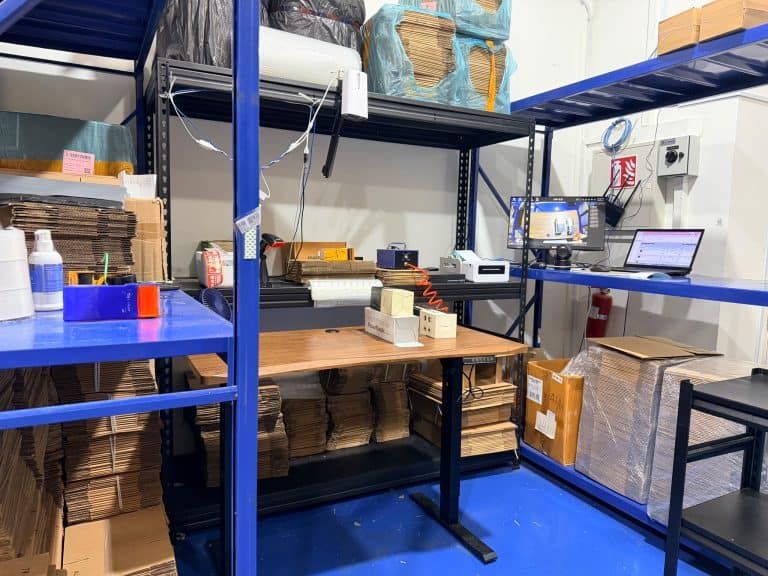
The integration between inbound freight and 3PL fulfilment is the critical handoff in your supply chain. Your forwarder delivers inbound cargo to BrickHub‘s Singapore warehouse, where goods are received, inspected, booked into inventory, and made available for order fulfilment. From there, BrickHub handles storage, pick and pack, and last mile delivery to your Singapore customers — or outbound shipping for regional distribution.
This end-to-end model — forwarder managing inbound freight, 3PL managing domestic fulfilment — is how professional ecommerce operations run at scale without owning warehouses or employing logistics staff. It eliminates the capital expenditure of infrastructure while maintaining service quality and next-day delivery capability. Learn more about BrickHub‘s 3PL warehousing and fulfilment services.
What Should You Look for in a Singapore Freight Forwarder?
When evaluating forwarders for your supply chain, prioritise: a licence as a Singapore Customs Declaring Agent, demonstrated experience on your specific trade lanes, capacity for both FCL and LCL shipments, real-time tracking, and transparent charge itemisation. Freight costs, origin handling, destination port handling, customs brokerage, and documentation fees should all be clearly listed. Avoid any forwarder who cannot provide a full landed cost breakdown before you commit to a shipment.
What to Look For in a Freight Forwarding Company in Singapore
Not all freight forwarders in Singapore operate at the same standard. For ecommerce brands and SMEs shipping internationally, choosing the right partner can mean the difference between on-time delivery and costly delays. Here’s what separates a reliable freight forwarder from a problematic one.
First, check licensing. Singapore freight forwarders handling customs clearance should be registered with Singapore Customs and hold the relevant Declaring Agent accreditation. For air freight, look for IATA (International Air Transport Association) accreditation. For sea freight, verify that the company is registered as a port agent or works with licensed shipping lines.
Second, look for multimodal capability. The best freight forwarders in Singapore handle air, sea, and land freight — giving you flexibility to switch modes based on urgency and cost. A forwarder that only handles sea freight will leave you stranded when a shipment needs to move faster.
Third, ask about insurance. Professional freight forwarders will arrange cargo insurance for your shipments. If a forwarder doesn’t raise this, ask — uninsured shipments leave you fully exposed to loss or damage claims.
Finally, look at their ecommerce track record. Freight forwarding for Shopee, Lazada, and Shopify sellers has specific requirements around labelling, documentation, and last-mile handoff. A forwarder with proven ecommerce experience will save you significant admin time.
For Singapore businesses, Singapore Customs maintains a register of licensed declaring agents. The Ministry of Transport oversees licensing for freight operators in Singapore.
Freight Forwarding Singapore 2026: Air vs Sea vs Land — Cost and Speed Breakdown
Choosing the right freight mode for Singapore imports and exports in 2026 comes down to three variables: cost per kilogram, transit time, and the nature of your cargo. Freight forwarding Singapore operators offer all three modes, and the right choice depends on your supply chain economics.
Air freight remains the fastest option — typically 3–7 days from major manufacturing hubs (Guangdong, Yiwu, Shanghai) to Singapore Changi. Cost runs SGD 8–20 per kg depending on carrier, route, and season. Air is the correct choice for high-value goods (electronics, jewellery), time-sensitive restocks, or shipments where the value-to-weight ratio justifies the premium. For ecommerce brands managing flash sales or seasonal launches, air freight is often the only viable option for responsive replenishment.
Sea freight (LCL/FCL) is the backbone of Singapore import volumes. Less-than-Container Load (LCL) shipments consolidate your cargo with others, with costs from SGD 80–200 per cubic metre. Full Container Load (FCL) becomes economical at volumes above approximately 10 CBM. Transit times from China run 5–12 days; from Europe, 20–35 days. Freight forwarding Singapore providers coordinate with the Port of Singapore — the world’s second-busiest by throughput — for reliable, high-volume sea freight operations. Singapore Customs handles all import declarations electronically via TradeNet.
Land freight via the Johor-Singapore Causeway or Second Link serves Malaysia and Thailand routes. Transit times of 1–3 days make it competitive with air for regional distribution, at significantly lower cost. However, land freight is limited to the ASEAN land corridor and is unsuitable for intercontinental cargo.
How Ecommerce Sellers Use Freight Forwarding to Cut Import Costs
For Singapore ecommerce brands importing from China or other manufacturing markets, strategic use of freight forwarding singapore services can meaningfully reduce landed cost per unit — a lever that directly widens product margins without changing retail pricing.
The primary mechanism is bulk import consolidation. Instead of importing stock in small, frequent air freight shipments (reactive and expensive), experienced ecommerce operators work with freight forwarders to plan quarterly or bimonthly sea freight shipments of consolidated stock. A full container of inventory imported via sea freight can cost 60–80% less per unit than the same goods air-freighted piecemeal. The trade-off is lead time — but with proper demand forecasting, that lead time is manageable.
Customs clearance is the second cost lever. A freight forwarder acting as your Declaring Agent ensures accurate HS code classification, correct CIF valuation, and compliant documentation — avoiding the delays, re-examination fees, and potential penalties that come from incorrect declarations.
The final link in the chain is last mile handoff. The best freight forwarding Singapore arrangements connect directly to your 3PL fulfilment partner. When goods arrive at port, they clear customs, transfer to the warehouse, and enter your live inventory — ready for order fulfilment within 24–48 hours of clearance. This seamless inbound handoff, coordinated by a forwarder who works with your 3PL regularly, eliminates the storage gaps and handling costs that eat into ecommerce margins.
BrickHub Singapore
Singapore's Trusted 3PL Partner
Fulfilment, warehousing, and last mile delivery for ecommerce brands — scale without the overhead.
Freight Forwarding Singapore 2026: Air vs Sea vs Land — Cost and Speed Breakdown
Choosing the right freight mode is one of the most consequential decisions an importer makes. In 2026, Singapore freight forwarders operate across three primary modes, each with distinct cost and speed profiles that suit different cargo types and business models.
Air freight remains the fastest option, with transit times of three to five days from major Asian manufacturing hubs such as Shenzhen, Guangzhou, and Kuala Lumpur. It is best suited for high-value, low-weight goods such as electronics, cosmetics, and fashion. Expect to pay approximately SGD 8–15 per kilogram, depending on volume and carrier.
Sea freight is the most economical option for bulk cargo. A full container load (FCL) from China to Singapore typically arrives in ten to eighteen days. Less-than-container-load (LCL) consolidation is available for smaller shipments, making sea freight accessible even for SMEs restocking inventory quarterly.
Land freight via the Johor–Singapore Causeway offers a compelling middle ground for goods originating in Malaysia. Transit times of one to two days at significantly lower costs than air make land freight popular for perishables and regional distribution. Check Singapore Customs for current documentation requirements.
How Ecommerce Sellers Use Freight Forwarding to Cut Import Costs
Ecommerce sellers who import goods from overseas suppliers have discovered that working with a freight forwarder — rather than shipping direct — consistently reduces their landed cost per unit. Here is how that saving is achieved in practice.
Freight forwarders consolidate shipments from multiple suppliers into a single container or air pallet, spreading the fixed costs of customs clearance and handling across more units. For a Shopee or Lazada seller importing from five different Chinese factories, consolidation alone can reduce freight costs by 20–35% compared with separate direct shipments.
Forwarders also leverage established carrier relationships to secure preferential rates unavailable to individual shippers. In 2026, with global air cargo demand normalising after post-pandemic volatility, competitive spot rates are again accessible through experienced freight partners.
Beyond cost, forwarders manage customs clearance Singapore-side, handling GST declarations, permits, and documentation — freeing the seller to focus on marketing and sales rather than logistics administration. Pair this with our ecommerce fulfilment Singapore service for a complete import-to-customer solution.
🏆 Singapore’s Leading Ecommerce Fulfilment Partner — Self Storage, 3PL & Last Mile Delivery | Rated 5⭐ on Google | Trusted by 200+ Singapore Ecommerce Sellers